
Introduction
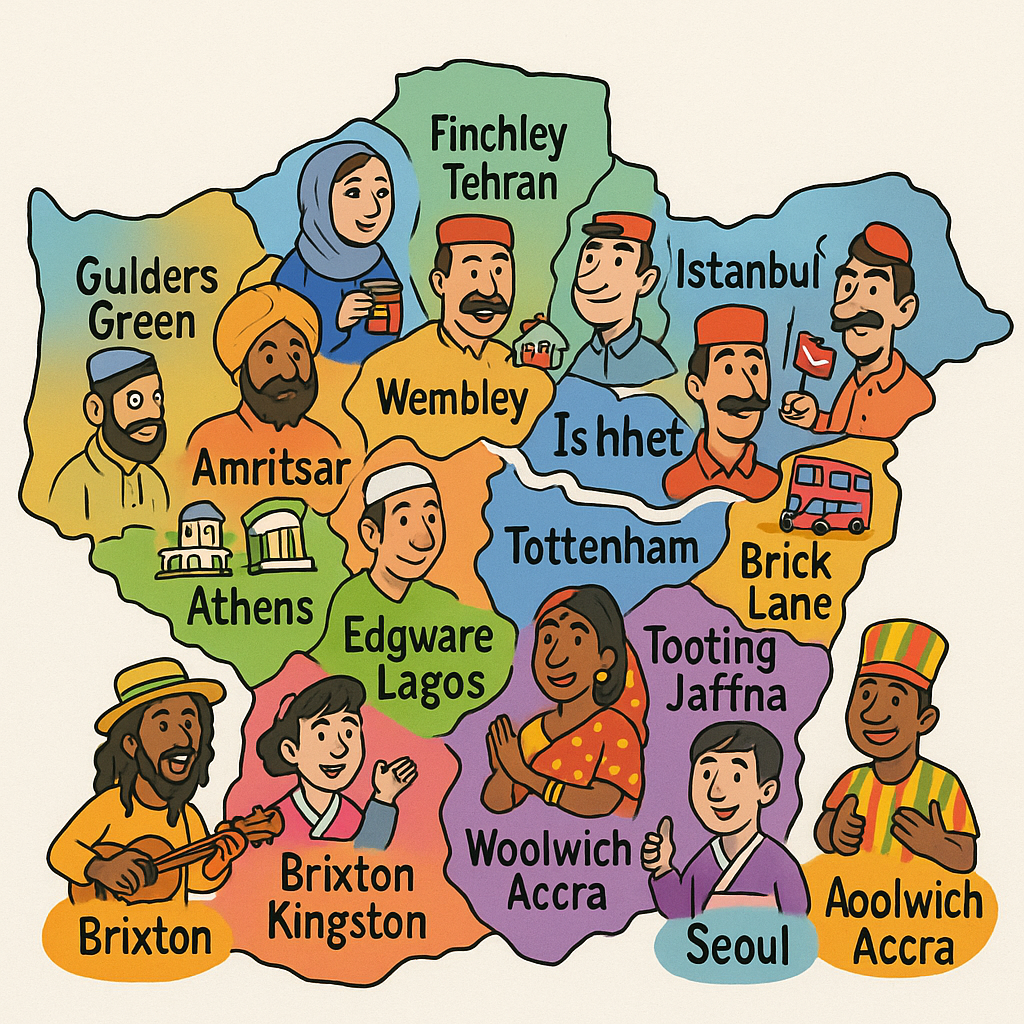
London is not just a city. It’s a world atlas bound within the M25. Its streets hum with hundreds of languages, its neighbourhoods pulse with the aromas of every continent, and its skylines – from mosques to mandirs, gurdwaras to synagogues – narrate the human story in full spectrum. While diversity in global cities like New York, Toronto, or Paris is well-known, what sets London apart is the depth of sub-ethnic concentration – entire communities not just of countries, but of regions, towns, even villages transplanted into boroughs.
This hyper-diversity – Sylhetis of Brick Lane, Patels of Wembley, Tamils of Tooting, Tel Avivian Jews of Golders Green – makes London more than multicultural. It makes it multicentric: a global city built on overlapping cultural capitals.
In this article, we’ll explore the sub-ethnic makeup of London, how it came to be, what it means for residents, and why this rich mosaic is London’s greatest asset.
1. What Is Sub-Ethnicity – and Why It Matters in London
Ethnicity refers to cultural identity rooted in language, religion, customs, or national origin. Sub-ethnicity digs deeper. It’s not just “Indian” but “Punjabi Sikh from Amritsar” or “Gujarati Hindu from Baroda.” It’s not just “Black British” but “Yoruba from Lagos” or “Afro-Caribbean from Kingston, Jamaica.” It speaks to cuisine, dialect, migration history, and community institutions.
In London, sub-ethnicity has flourished thanks to:
- Chain migration patterns: One family brings others from the same town.
- Housing and job clustering: Council policies in the ‘60s–‘80s helped settle groups in specific boroughs.
- Religious infrastructure: Mosques, gurdwaras, churches, temples create hubs.
- Language and retail ecosystems: Shops, doctors, schools, and even Uber drivers often speak community languages.
2. London’s Sub-Ethnic Hotspots: A Borough-by-Borough Portrait
🕌 Tower Hamlets: Sylhet in the City
Whitechapel and Brick Lane are home to one of the largest Bangladeshi-Sylheti communities outside South Asia. More than 35% of Tower Hamlets residents are Bangladeshi, predominantly from Sylhet. Brick Lane is affectionately dubbed Banglatown, boasting curry houses, Bengali bookshops, and community media.
🛕 Ealing – Southall: The Soul of Punjab
Known as Little Punjab, Southall’s Broadway thrums with the sound of dhols and the waft of jalebis. The majority here are Punjabi Sikhs and Hindus from Amritsar, Patiala, and Jalandhar. Southall is also home to Europe’s largest Gurdwara – Sri Guru Singh Sabha.
🕌 Hounslow – Hayes: Lahore in London
West London’s Hayes and Cranford reflect the tapestry of Pakistan’s Punjab province – particularly Lahore and Faisalabad. Urdu, Punjabi, and Pahari are widely spoken, and vibrant mosque communities and halal businesses dominate the high streets.
🛕 Brent – Wembley: Gujarat’s Global Capital
Wembley and Alperton are overwhelmingly Gujarati, especially the Patidar community. Neasden Temple – the largest Hindu temple outside India – is a cultural and architectural anchor. Vegetarian thali joints and garba dance festivals flourish.
🕍 Barnet – Golders Green & Finchley: Tel Aviv to Tehran
Northwest London is home to the UK’s largest Jewish community, but with sub-ethnic diversity: Orthodox Ashkenazi Jews in Golders Green; Persian Jews in Finchley; and a growing Israeli expat scene. Hebrew street signs and kosher supermarkets are standard.
🇹🇷 Haringey – Green Lanes: From Istanbul to Diyarbakir
Green Lanes in Haringey is a Turkish-Kurdish corridor. Shops sell simit, women wear Anatolian headscarves, and conversations echo in Turkish, Kurdish, and Zaza. The area reflects both secular and conservative migrants from Turkey.
🇬🇷 Enfield – Palmers Green: Athens Meets Famagusta
Nicknamed Palmers Greek, Enfield is home to Greek Cypriots and mainland Greeks, many settled post-1974 Cyprus conflict. The Greek Orthodox Church, Cypriot social clubs, and meze restaurants offer a slice of the Aegean.
🇯🇲 Lambeth – Brixton: Jamaica’s Cultural Embassy
From reggae shops to Caribbean bakeries, Brixton holds tight to its Jamaican roots. The Windrush generation first settled here, and their descendants maintain vibrant political, musical, and religious institutions – including Pentecostal and Rastafarian churches.
🇳🇬 Southwark – Peckham: The Lagos of London
With signs in Yoruba, Nollywood DVDs, and Nigerian churches, Peckham is London’s “Little Lagos.” It’s a hub for both Christian and Muslim Nigerian communities, from the Igbo, Yoruba, and Hausa tribes.
🇬🇭 Greenwich – Woolwich: Accra’s Anchor
Greenwich has a large Ghanaian population, with Woolwich hosting numerous Pentecostal churches, Ghanaian restaurants, and community associations.
🇱🇰 Wandsworth – Tooting: Jaffna in the South
Tooting is the Tamil capital of the UK – home to Tamils from Sri Lanka’s north (Jaffna) and Tamil Nadu. Temple festivals, Bharatanatyam dance schools, and Tamil newspapers thrive here.
🇰🇷 Kingston – New Malden: The Seoul of Surrey
Europe’s largest Korean population lives in New Malden. Korean churches, barbecue restaurants, and supermarkets abound. Even street signs are bilingual in English and Hangul.
🇸🇴 Hackney / Tower Hamlets: Mogadishu in the East
Somali communities cluster in Stepney, Dalston, and Bethnal Green. Many are refugees from civil war, and Somali cafes, mosques, and businesses have transformed parts of East London.
Below is a snapshot of London’s best-known ethnic “hot-spots”. It pairs each borough (or well-defined neighbourhood within a borough) with the sub-ethnic communities that dominate there and the data-point or study that evidences their concentration. Percentages come from the 2021 Census unless otherwise noted.
| Borough / Neighbourhood (postcode-shorthand) | Leading sub-ethnic concentration | 2021 Census / study highlight |
|---|---|---|
| Tower Hamlets – Whitechapel / Brick Lane (E1) | Bangladeshi (Sylheti) | 34.7 % of residents Bangladeshi – highest single-minority share of any UK borough |
| Ealing – Southall (UB1-UB2) | Punjabi Sikhs & Hindus (Amritsar) | Long tagged “Little Punjab”; largest Punjabi Sikh enclave in Western Europe |
| Hillingdon – Hayes (UB3-UB4) | Punjabi Muslims & Sikhs | Punjabis form the biggest non-UK born group in Hayes & Harlington MSOAs |
| Brent – Wembley / Alperton (HA0-HA9) | Gujarati Hindus & Jains (Gujarat/Patidar) | Ealing Rd described as “London’s answer to Belgrave Rd” for Gujaratis |
| Barnet – Golders Green / Hendon / Finchley (NW11-N12) | Jewish (Ashkenazi & Charedi); growing Persian-Jewish & Israeli cluster | 56,616 Jews – largest of any UK borough (2021) |
| Barnet – Finchley Central / North Finchley (N3-N12) | Iranian Persians (Tehran) | Community forums call Finchley & Hendon “the new Kensington” for Iranians |
| Haringey – Tottenham / Wood Green (N15-N22) | Turkish & Kurdish (Istanbul/Diyarbakır) | ≈90 % of UK Turks live in London, highly visible along Green Lanes strip |
| Enfield – Palmers Green / Southgate (N13) | Greek-Cypriot (Athens/Famagusta) | “Palmers Greek” hosts the largest Greek-Cypriot community outside Cyprus |
| Lambeth – Brixton (SW2-SW9) | Jamaican & wider Afro-Caribbean (Kingston) | Area noted for high Afro-Caribbean share since Windrush era |
| Southwark – Peckham (SE15) | Nigerian (Yoruba/Igbo) – “Little Lagos” | 5,250 Nigerian-born residents (2011) & hub for 115k-strong London Nigerian diaspora |
| Greenwich – Woolwich / Thamesmead (SE18-SE28) | Ghanaian & Nigerian | Greenwich one of 10 boroughs with largest Ghanaian clusters in London |
| Westminster – Edgware Road (W2/W1) | Arab (Lebanese, Egyptian, Gulf) – “Little Cairo/Beirut” | Westminster has highest density of Arabic speakers; Edgware Rd lined with Arab cafés & book-shops |
| Wandsworth – Tooting (SW17) | Sri-Lankan Tamils (Jaffna/Colombo) | One of three London hubs with the largest British-Tamil populations |
| Kingston-upon-Thames – New Malden (KT3) | Korean (Seoul & sizeable North-Korean diaspora) | 10-20 k Koreans – largest “Korea Town” in Europe |
| Tower Hamlets / Hackney fringes – Stepney, Bethnal Green, Dalston (E1-E8) | Somali (Mogadishu) | London hosts 65,333 Somali-born (2011), heavy clustering in E1/E2/E8 wards |
3. The Benefits of Sub-Ethnic Density
This unique form of urbanism has several benefits:
🧠 Cultural Continuity
Maintaining sub-ethnic traditions – be it Ramadan bazaars, Durga Puja festivals, or Shabbat services – ensures mental well-being and identity for first-generation migrants and their children.
🏥 Ethnically-Competent Services
Local GPs, schools, and businesses reflect community needs – from halal meat to Tamil-speaking teachers, Black barbers to Bengali midwives.
🤝 Social Cohesion Within Diversity
While critics warn of “self-segregation,” research shows London’s communities are highly interactive: residents often live, work, and study in mixed settings while still finding comfort in culturally specific spaces.
🛍️ A Marketplace of Cultures
From Brick Lane’s curries to Ridley Road Market’s African fabrics, from Korean spas in New Malden to Lebanese bakeries on Edgware Road, Londoners enjoy an unmatched variety of goods, tastes, and experiences.
4. Challenges and Critiques
London’s cultural clustering does raise valid challenges:
- Housing inequality: Ethnic minority groups often face overcrowding, poor housing, or gentrification pressures.
- Language barriers: In some boroughs, under 60% of children speak English as their first language.
- Under-representation: Some sub-ethnic communities lack political voice or media visibility despite numbers.
- Islamophobia, antisemitism, and racism: Hate crimes remain a persistent threat for minority communities.
Yet London’s strength lies in how communities mobilise against these – through community organising, interfaith work, and cultural education.
5. A City That Rewrites the National Story
Contrary to far-right narratives that frame diversity as dilution, London proves it is a multiplier. The city’s status as a global financial hub, culinary capital, and innovation centre owes everything to its mosaic of immigrants and their children.
The story of London is no longer just of Big Ben and Buckingham Palace. It’s of:
- A Somali mother in Tower Hamlets running a STEM club
- A Nigerian tech entrepreneur in Peckham
- A Jewish-Iranian restaurateur in Finchley
- A Tamil NHS doctor in Tooting
- A Bengali poet on Brick Lane
Conclusion: Why London Remains the Best City to Live In
London is not perfect – housing is expensive, transport is busy, and politics is fraught. But no other global city offers such a richly woven fabric of distinct-yet-intertwined sub-ethnic communities.
It is not a melting pot. It is a quilt – each patch proud of its heritage, stitched together by shared public space, aspiration, and humour.
To live in London is to live in Lahore and Lagos, Jaffna and Jerusalem, Accra and Athens, all at once.
That is not only beautiful – it’s powerful. And it’s why, for millions, London is home in every sense of the word.
#MulticulturalLondon #DiversityMatters #SubEthnicity #GlobalCity #UrbanIdentity #LondonLife #SylhetToSouthall #BrixtonToBrickLane


