
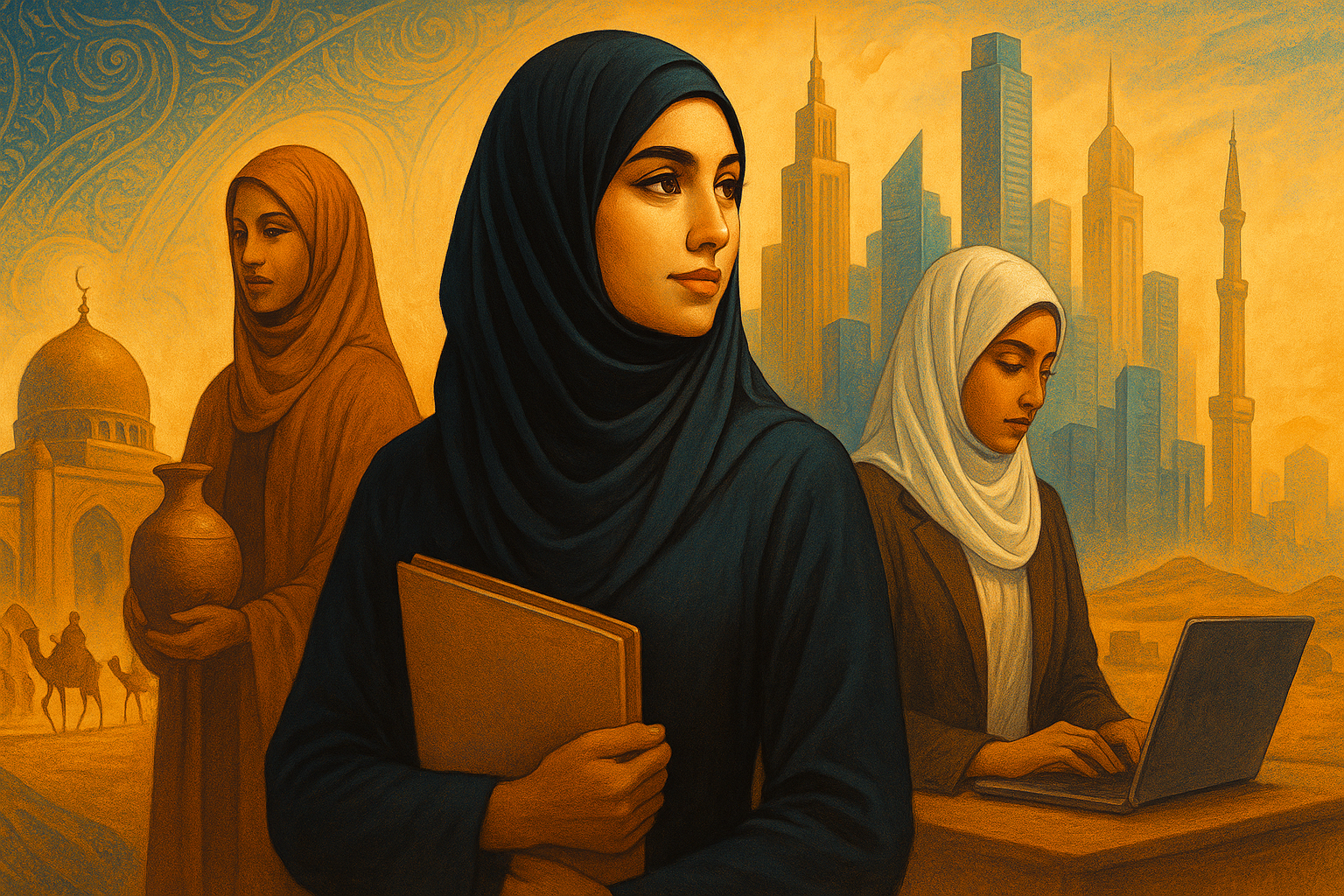
Muslim women have a long legacy of entrepreneurship – in trade, scholarship, philanthropy, and social leadership – rooted in Islamic legal rights to own property and conduct business. Islamic law granted women independent ownership and the right to trade, a foundation that early Muslims embraced. In the 7th century Khadījah bint Khuwaylid (d. 619), the first wife of Prophet Muḥammad, epitomized this ideal: a Quraysh merchant whose caravan enterprise rivaled those of all Meccan tribes. Khadījah reinvested her wealth in the nascent Muslim community, using her fortune to fund the early Islamic movement. Likewise, other Prophet-era women displayed entrepreneurial initiative: for example, Zaynab bint Khuzayma (“Mother of the Poor”) and Zaynab bint Jahsh (“Longest Hand”) were famed for lavish charity, and Rufaydah al-ʿAslamīyah established Islam’s first field hospital using her own resources. These early examples show that, from Islam’s inception, women leveraged inheritance, trade, and philanthropy to support education, welfare, and community-building.
Early Islamic Era (7th–8th centuries)
During Muḥammad’s lifetime and the immediate Caliphal period, Muslim women were active in commerce and charity. Khadījah bint Khuwaylid, for instance, inherited her mercantile husbands’ businesses and grew a trading empire so vast that later historians note “over time, her trade caravans became almost as large as the caravans of all Quraysh”. As a wealthy widow she hired agents and managed multi-ship caravan ventures, a commercial practice (muḍārabah) that later became an Islamic finance model. She used her profits not to hoard wealth but “strategically to support the nascent Muslim community”, paying for Quraysh detainees, freedom of enslaved converts, and aiding the poor. Similarly, other early Muslim women received incomes and made economic choices: ʿĀ’ishah bint Abī Bakr was entrusted with charitable funds (drawing allowance for the ʿAṣḥāb al‑Ṣuffah), while ʿUmmʿĀtī (Ẓaynab bint Jahsh) inherited property that she donated in waqf (religious endowment). These cases illustrate that Islamic teaching – which “provided clear-cut strategies for empowering women” – encouraged women’s economic agency.
The Classical and Medieval Period (8th–15th centuries)
As the Islamic world expanded, women entrepreneurs appeared across regions. In North Africa, Fatima al‐Fihrī (c.800–880) left her family’s fortune to found the al-Qarawiyyīn Mosque and school in Fez, Morocco – a religious and educational complex that grew into the world’s oldest operating university. Chroniclers emphasize that Fatima and her sister chose sadaqah (charity) over commerce, investing in community education rather than accumulating wealth. Fatima personally oversaw construction of the mosque-madrasa in 857–859 CE, and the institution became a leading center of Islamic learning (from which figures like Maimonides and Ibn Khaldūn later studied).
In the Eastern Islamic lands and India, royal women became de facto entrepreneurs. Historians note that Mughal queens engaged directly in trade and financing. For example, Empress Maryam-uz-Zamanī (Akbar’s wife and Jahāngīr’s mother) owned large merchant ships and traded on Red Sea routes. When the massive ship Rahīmī (over 1,000 tons) sailed from Surat to Mocha in 1613, its owner was “a woman, Maryam-uz-Zamanī”. Likewise, her daughter-in-law Ẓahrah “Nūr Jahān” (r. 1611–27) privately invested in textiles (silk and indigo) and colonial trade: she “owned ships, dabbled in indigo, [and] was particularly interested in the embroidered-cloth trade,” even managing customs duties and foreign partnerships. Jahānārā Begum (Shāh Jahān’s daughter) was granted the revenues of Surat’s port (the Mughal Empire’s richest port) and reinvested them in public works; she built roads and even owned a grand caravanserai in Delhi for elite merchants. These Mughal princesses illustrate that imperial women, though usually in purdah (seclusion), wielded immense wealth and influenced commerce – a point underscored by historians who argue that their examples remind us how premodern women “managed to step beyond the threshold” of domesticity.
In the Ottoman world (14th–19th centuries), elite Muslim women also used capital to launch institutions. Courtly princesses and sultans’ mothers endowed charitable waqfs on par with men’s. For instance, Hürrem (Roxelana), Suleiman’s wife, founded an Istanbul soup kitchen attached to a mosque, school and hospice. Kösem Sultan (mother of Murad IV and Ibrahim) established an endowment to provide marriage-dowries for poor girls. In Jerusalem under Ottoman rule, women founded 56 of 300 waqfs recorded (1703–1831) – many as family trusts that preserved women’s property and later funded charity. An Ottoman-era study notes that over 1,400 awqāf (endowments) in the empire were established by women. Across cultures, therefore, Muslim women from Andalusia to Anatolia invested in schools, mosques, hospitals and markets, driven by religious duty (zakāt/sadaqah) and a sense of public service.
Colonial and Early 20th Century
During the 19th and early 20th centuries – an era of colonialism and modern reform – Muslim women continued to lead enterprises in education, philanthropy, and commerce. In British India, the princely State of Bhopal was ruled (1819–1926) by four successive Begums. Sikandar Begum (r.1860–68) was a noted reformer who opened girls’ schools: she founded the Victoria School in Bhopal to teach basic academics and vocational trades to poor Hindu and Muslim girls. Her granddaughter Sultan Jahan Begum later expanded women’s education across the state. In Bengal, Begum Rokeya Sakhawat Hossain (1880–1932) used her inheritance to pioneer Muslim women’s education under colonial rule. After her husband’s death she started a girls’ school from home and in 1911 established the Sakhawat Memorial Girls’ School in Calcutta. This school taught literacy and vocational skills to purdahnāshin (veiled) girls and became a model for women’s schooling in South Asia. Rokeya also organized women’s literary societies (Anjuman-i-Khawātīn-i-Islām) and published feminist works, showing how social entrepreneurship and writing combined to advance women’s empowerment.
Elsewhere, leading women channeled wealth into social causes. In Ottoman Egypt, for example, wealthy women founded charitable societies and schools (though detailed citations are sparse here, Hürrem’s and Kösem’s philanthropy set precedents). In West Africa and Southeast Asia during the colonial era, educated Muslim women began forming modern associations and business clubs, often blending traditional Islamic ethics with new capitalist enterprise. (For instance, Malayalee Muslim women in British Malabar established needlework cooperatives, and West African women traders in Hausa lands navigated both Islamic markets and colonial regulations – detailed histories exist but require specialized sources.) Across colonies, women entrepreneurs also navigated patriarchal and colonial constraints, illustrating the tension: as one historian notes, even among the wealthiest women “the desire to step beyond domesticity… can be traced across different cultures and contexts”, a through-line from medieval to modern times.
Contemporary Period (Mid-20th century to Today)
In the post-colonial era, Muslim women entrepreneurs have become highly visible globally, across both majority-Muslim societies and diasporas. In recent decades the Gulf and Middle East have seen an economic shift: governments consciously include women in post-oil diversification. Women-founded startups are rising in Saudi Arabia, UAE, Egypt and beyond. For example, Emirati entrepreneur Mona Ataya launched Mumzworld, a leading e-commerce platform serving 2.5 million mothers in the Gulf. Saudi-born Iman Abuzeid (a Wharton-trained physician) co-founded healthcare staffing unicorn Incredible Health (valued at $1.65 billion). Turkish scientist Dr. Derya Baran used research funding to start RedSea Technologies (agri-tech), raising over $37 million to commercialize water-saving farming tech. These women cite a mix of market insight and cultural understanding: as World Economic Forum observers note, female founders in the region “have a nuanced understanding of local market dynamics” in areas like education, health and finance. Governments too have launched programs (e.g. Saudi Vision 2030, UAE empowerment strategies) and private initiatives (Visa’s “She’s Next” grants) to bolster women-led ventures. At the same time, hurdles remain: women-led startups still receive only ~1.2% of MENA venture capital, reflecting ongoing social barriers.
In South Asia, women entrepreneurs and social entrepreneurs are prominent. In Pakistan, Roshaneh Zafar created the Kashf Foundation (1996), the country’s first microfinance institution for women; it has since served millions of female entrepreneurs and even issued Pakistan’s first “gender bond”. Bangladesh’s Reshma Khatun pioneered cottage-industry enterprises in rural areas (though more examples exist among later generations). In Indonesia and Malaysia, Muslim women lead prominent firms and NGOs (for instance, Indonesia’s Wardah Cosmetics, founded by its Muslim woman CEO, became a national brand). Across Africa, women like Senegalese tech entrepreneur Magatte Wade or Nigerian business leader Folorunsho Alakija (though the latter is Christian) point to the growing, if underreported, number of Muslim women in commerce and industry.
Among Muslim minorities in the West, there is also a rising wave of entrepreneurship. In the UK, media report a “rapidly expanding community of Muslim female entrepreneurs”. In 2023 London’s Saverah Awards honored dozens of British Muslim businesswomen across sectors (tech, beauty, food, SMEs) to celebrate their success. In the United States and Canada, women of Muslim or Middle Eastern heritage are key players in tech startups. For example, Sudanese-American Dr. Iman Abuzeid (mentioned above) exemplifies this trend, as do companies founded by Iraqi-Canadian Layla Shaikley (logistics software) and Lebanese-Canadian Ayah Bdeir (electronics kits). The diaspora’s achievements often blend cultural identity with innovation – for instance, Pakistani-American designer Sharmeen Obaid-Chinoy (Nobel laureate filmmaker) has launched media ventures, while Somali-born Ilhan Omar (US Congresswoman) partners with entrepreneurs to foster community programs. Overall, Muslim women today run everything from large corporations (e.g. Emirates Airline’s chief) to local nonprofits (e.g. activists like Naheed Murad of Pakistan’s ZACAH refugee aid group), showing the broad scope of “entrepreneurship” in social, political, and business spheres.
Analysis of Contexts
These entrepreneurial trajectories were shaped by varying social, religious, and political contexts. Classical Islamic sources – the Qur’an and Ḥadīth – emphasize charity, education, and ethical commerce for all believers. Early Muslim jurists affirmed women’s rights to inherit and manage property (Qur’an 4:7,19), meaning women could legally contribute capital and own businesses. Historically, when political power centralized (e.g. imperial courts), women at the top used it to found schools, hospitals, and markets (as seen with Ottoman sultanas or Mughal begums). Conversely, in periods of decentralization or cultural conservatism, women often exercised influence through family waqfs or within the household. For example, the Jerusalem waqf records suggest that under Ottoman patriarchy most women established family endowments (for their heirs) rather than public charities.
Religiously, the entrepreneurial roles of Muslim women have been framed as continuations of the Prophet’s example and the Qur’anic vision of social welfare. The Prophet’s wife Ā’ishah and companions like ʿUmm Salamah were renowned for sponsoring scholars and needy converts, reinforcing that Islamic virtue rewards community investment. Islamic teaching also stresses the dignity of trade and earning honest income; thus a woman like Khadījah is celebrated as both “al-Kubrā” (the Great One) and a righteous businesswoman. Throughout history, pious women often used charitable entrepreneurship (waqfs, zakāt-funded schools) to “add to the social and economic wellbeing of society”.
Politically, Muslim women’s entrepreneurial influence ebbed and flowed with their civil status. In empires like the Mughals and Ottomans, the harem-courts could simultaneously restrict women (seclusion, guardianship rules) and empower them (patronage of public works). Colonialism introduced new constraints (western-style patriarchy, education limitations) but also new opportunities (mission schools, reformist movements). In South Asia’s nationalist era, for instance, many Muslim women entrepreneurs blended modernist education with religious values, founding institutions to uplift women (as with Begum Rokeya). The late 20th century’s globalization and feminist ideas further expanded niches – from halal fashion markets to faith-based NGOs – enabling Muslim women to claim entrepreneurial spaces that marry cultural identity with economic innovation.
Islamic Teachings and Precedents
Throughout, Islamic principles provided precedents encouraging women’s economic roles. Scholars point out that Islam’s very earliest texts (e.g. Quranic laws of inheritance in an-Nisā’ chapter) emphasize women’s financial autonomy. One analysis notes that Islamic law “has provided clear-cut strategies for empowering women” economically, and that proper implementation of women’s property rights “will promote female entrepreneurship”. The examples above – a merchant wife, a scholar-funder of a university, royal investor-queens – are often cited by modern Islamic feminists as normative precedents. In many Muslim societies, ḥadīth and jurisprudence not only permit but sometimes commend women’s engagement in commerce (so long as ethical guidelines are followed). In practice, though, cultural patriarchy has often limited this potential; part of the modern narrative is reclaiming those early precedents to inspire today’s entrepreneurs.
Conclusion: Inspiration for Today’s Women
The chronicle of Muslim women entrepreneurs shows both continuity and change. From Khadījah’s caravans to the CEO suites of Silicon Valley, there is a thread of ambition aligned with purpose. Historian Aparna Kapadia concludes that stories like Maryam-uz-Zamanī’s are “the tip of the iceberg of women’s work outside the home in the ‘pre-modern’ past”. They remind us that the drive to “step beyond domesticity” is neither the invention of a particular place nor of modernity, but has always existed. For modern Muslim (and non-Muslim) women, these examples offer role models who combined faith with entrepreneurship and leadership. The legacy of these pioneering women teaches that social constraints can be overcome: women “managed to step beyond the threshold” of traditional roles even centuries ago.
Today’s female entrepreneurs can draw on this heritage of ethical entrepreneurship. Islamic teachings on social justice, stewardship (amānah) and charity continue to inspire business models that balance profit with purpose. The historic precedent of a Muslim woman funding schools or trade enterprises suggests to modern women the legitimacy of leading similar initiatives. As Muslim women assume more public economic roles worldwide, their stories – whether medieval queen or contemporary startup founder – send a powerful message that capability and vision transcend gender. In sum, the history of Muslim women entrepreneurs is one of deep roots and broad reach. Their achievements across time and cultures stand as testament and inspiration: showing that women, drawing on their values and talents, can forge paths of enterprise and leadership for the benefit of all.
Sources: Historical and academic accounts were drawn from classical chronicles and modern scholarship (see citations). Key examples and analyses are documented in peer-reviewed journals and respected histories, illustrating the broad scope of Muslim women’s entrepreneurship from the Prophet’s era to today.

